Quiz IIA-CIA-Part3 - Trustable Test Internal Audit Function Simulator Online
BTW, DOWNLOAD part of BraindumpsPrep IIA-CIA-Part3 dumps from Cloud Storage: https://drive.google.com/open?id=1t2VhON0O4SxwA7d6hUlGHv_E8TaPbeSm
IIA-CIA-Part3 training materials are famous for high quality, and we have received many good feedbacks from our customers. IIA-CIA-Part3 exam materials are compiled by skilled professionals, and they possess the professional knowledge for the exam, therefore, you can use them at ease. In addition, IIA-CIA-Part3 training materials contain both questions and answers, and it’s convenient for you to have a check after practicing. Yu can receive download link and password within ten minutes after paying for IIA-CIA-Part3 Exam Braindumps, it’s convenient. If you don’t receive, you can contact us, and we will solve this problem for you as quickly as possible.
IIA IIA-CIA-Part3 Exam Overview:
| Certification Vendor: | IIA (The Institute of Internal Auditors) |
|---|---|
| Exam Name: | Internal Audit Function |
| Exam Number: | IIA-CIA-Part3 |
| Exam Duration: | 120 minutes |
| Real Exam Qty: | 100 |
| Exam Price: | USD 280 (IIA Member) / USD 415 (Non-member) / USD 215 (Student) |
| Certificate Validity Period: | CIA certification requires ongoing CPE; exam scores valid for program window (typically 3 years) |
| Exam Format: | Multiple Choice Questions |
| Passing Score: | 600 (scaled score out of 750) |
| Available Languages: | Arabic, Indonesian, Korean, French, Japanese, Polish, Turkish, Traditional Chinese, Portuguese, Simplified Chinese, Russian, Spanish, German, Thai, English |
| Related Certifications: | Certified Internal Auditor (CIA) |
| Sample Questions: | IIA IIA-CIA-Part3 Sample Questions |
| Exam Way: | Computer-based testing at Pearson VUE test centers worldwide. As of May 28, 2025, online proctored testing has been discontinued; all exams must be taken in-person at authorized Pearson VUE testing centers. |
| Pre Condition: | Candidates must have an active CIA program enrollment through The IIA's Certification Candidate Management System (CCMS). A bachelor's degree or equivalent is required for CIA certification. Part 3 can be taken in any order, but all three parts must be passed within the program eligibility window (typically 3 years from acceptance). |
| Official Syllabus URL: | https://www.theiia.org/globalassets/certifications/cia-exam-syllabus/cia-part-3-syllabus.pdf |
>> Test IIA-CIA-Part3 Simulator Online <<
IIA-CIA-Part3 Free Test Questions, IIA-CIA-Part3 Valid Exam Testking
IIA-CIA-Part3 is the authentic study guides with the latest exam material which can help you solve all the difficulties in the actual test. Our IIA-CIA-Part3 free demo is available for all of you. You will receive an email attached with the IIA-CIA-Part3 training dumps within 5-10 minutes after completing purchase. Immediately download for the IIA-CIA-Part3 study pdf is available for study with no time wasted. We have money refund policy to ensure your interest in case the failure of IIA-CIA-Part3 actual test.
IIA-CIA-Part3 Exam is a computer-based exam that consists of 100 multiple-choice questions. IIA-CIA-Part3 exam is divided into two parts, with the first part consisting of 30 questions that cover general business knowledge, and the second part consisting of 70 questions that cover more specific areas of internal auditing. Candidates are given 2.5 hours to complete the exam, and must achieve a score of at least 600 out of 750 to pass. Successfully passing IIA-CIA-Part3 exam is a significant achievement for anyone looking to advance their career in internal auditing.
IIA-CIA-Part3 exam is a globally recognized certification that is highly valued by employers, and it is designed to help internal auditors advance their careers by demonstrating their knowledge and skills in the field of business. IIA-CIA-Part3 Exam is open to all individuals who meet the eligibility requirements, which include having a bachelor's degree or equivalent and two years of internal audit experience or its equivalent.
In order to be eligible to take the IIA-CIA-Part3 exam, candidates must have completed the IIA-CIA-Part1 and IIA-CIA-Part2 exams or have obtained a waiver. They must also meet the IIA's experience requirements, which vary depending on their educational background. Overall, the IIA-CIA-Part3 certification exam is a challenging but rewarding certification that can help internal auditors take their careers to the next level.
IIA Internal Audit Function Sample Questions (Q82-Q87):
NEW QUESTION # 82
Internal auditors want to increase the
likelihood of identifying very small control and transaction anomalies in their
testing that could potentially be exploited to cause material breaches. Which of
the following techniques would best meet this objective?
- A. Analysis of the databases of partners, such as suppliers.
- B. Verification of the completeness and integrity of existing data.
- C. Analysis of the full population of existing data.
- D. Continuous monitoring on a repetitive basis.
Answer: C
Explanation:
To identify very small control and transaction anomalies,
internal auditors should analyze the entire dataset rather than a sample. Full
population analysis increases the likelihood of detecting:
Unusual
transaction patterns, including fraud, errors, and control weaknesses.
Rare
or subtle anomalies that might be missed in sampling-based
audits.
Machine-learning-based fraud detection and exception analysis.
A).
Analysis of the full population of existing data. (Correct)
This approach
ensures complete coverage, reduces sampling risk, and detects rare
anomalies.
Modern data analytics tools allow auditors to analyze entire
datasets efficiently.
B). Verification of the completeness and integrity of
existing data. (Incorrect) While data integrity checks ensure reliable data,
they do not actively identify anomalies or suspicious patterns.
C).
Continuous monitoring on a repetitive basis. (Incorrect, but relevant)
Continuous monitoring is useful for ongoing fraud detection, but it does not
guarantee full anomaly detection unless it covers all transactions.
Full
population analysis is more comprehensive for identifying small
anomalies.
D). Analysis of the databases of partners, such as suppliers.
(Incorrect) While analyzing external data sources can uncover vendor fraud, it
does not address internal control or transaction anomalies within the
organization.
IIA GTAG 3 - Continuous Auditing recommends full population
analysis as a best practice for anomaly detection.
IIA Standard 1220 - Due
Professional Care requires auditors to use advanced analytical techniques to
detect control weaknesses.
COSO Framework - Fraud Risk Management Guide
suggests full transaction data analysis for effective fraud
detection.
Explanation of Answer Choices:IIA References:Thus, the correct
answer is A. Analysis of the full population of existing data.
NEW QUESTION # 83
In Year 2, the entity had cash
provided by operations of:
- A. US $344,000
- B. US $219,000
- C. US $469,000
- D. US $244,000
Answer: B
Explanation:
Cash provided by operations equals profit, plus depreciation,
minus the increase in accounts receivable, minus the decrease in accounts
payable. The cash provided is US $219,000 [$294,000 + $50,000 -$300,000 -
$200,000) -$275,000 - $250,000)]. An increase in receivables is a noncash
component of profit. A decrease in accounts payable is added when adjusting cost
of goods sold to reflect cash paid to suppliers. Thus, it is subtracted when
adjusting profit to arrive at cash provided by operations. An entity has the
following statements:
NEW QUESTION # 84
An internal auditor found the
following information while reviewing the monthly financial siatements for a
wholesaler of safety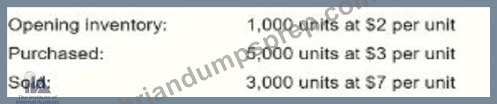
The
cost of goods sold was reported at $8,500. Which of the following inventory
methods was used to derive this value?
- A. First-in, first-out (FIFO) method
- B. Activity-based costing method
- C. Average cost method
- D. Specific identification method
Answer: A
Explanation:
To determine which inventory method was used, we calculate
the cost of goods sold (COGS) under different inventory valuation methods.
*
Opening Inventory: 1,000 units @ $2 each = $2,000
* Purchased: 5,000 units @
$3 each = $15,000
* Total Inventory: 6,000 units
* Units Sold: 3,000 at $7
per unit
* Reported COGS: $8,500
Given Data:FIFO Calculation:FIFO
(First-In, First-Out) assumes that the oldest inventory is sold first.
*
1,000 units from opening inventory @ $2 = $2,000
* 2,000 units from purchases
@ $3 = $6,000
* Total COGS under FIFO: $2,000 + $6,000 = $8,000
Average
Cost Calculation:Average cost per unit =
Total Cost of InventoryTotal
Units=(2,000+15,000)6,000=17,0006,000=2.83 per unit\frac{\text{Total Cost of
Inventory}}{\text{Total Units}} = \frac{(2,000 + 15,000)}{6,000} =
\frac{17,000}{6,000} = 2.83 \text{ per unit}Total UnitsTotal Cost of
Inventory=6,000(2,000+15,000)=6,00017,000=2.83 per unit
* COGS using average
cost method: 3,000×2.83=8,4903,000 \times 2.83 = 8,4903,000×2.83=8,490 This is
not an exact match to the reported COGS of $8,500.
Since the closest method
to the reported value is FIFO ($8,000 vs. $8,500 reported COGS, accounting for
possible rounding errors or additional costs), FIFO is the most likely method
used.
* (A) Average cost method. # Incorrect. The calculated COGS using the
weighted average method was
$8,490, which does not match exactly with the
reported COGS of $8,500.
* (B) First-in, first-out (FIFO) method. # Correct.
The FIFO method yielded $8,000, which is the closest match to the reported COGS.
Minor rounding adjustments or other expenses could explain the difference of
$500.
* (C) Specific identification method. # Incorrect. This method applies
when each inventory item is individually tracked, which is not mentioned in the
question.
* (D) Activity-based costing method. # Incorrect. Activity-based
costing (ABC) is used for overhead allocation and is not a primary inventory
valuation method.
* IIA GTAG - "Auditing Inventory Management"
* IIA
Standard 2130 - Control Activities (Inventory and Costing Methods)
* GAAP and
IFRS - FIFO, Weighted Average, and Specific Identification Methods Analysis of
Answer Choices:IIA References:Thus, the correct answer is B (FIFO method)
because it provides the closest cost match to the reported COGS.
NEW QUESTION # 85
According to IIA guidance, which of
the following is an IT project success factor?
- A. Inclusion of critical features, rather than inclusion of an array of supplementary features.
- B. Streamlined decision-making, rather than building consensus among users.
- C. Focus on flexibility and adaptability, rather than use of a formal methodology.
- D. Consideration of the facts, rather than consideration of the emotions displayed by project stakeholders.
Answer: A
Explanation:
According to IIA guidance on IT project success, successful
IT projects focus on delivering critical, high- value features that support
business objectives rather than overloading with unnecessary features.
Let's
analyze each option:
* A. Streamlined decision-making, rather than building
consensus among users.
* Incorrect. While efficient decision-making is
important, user consensus is crucial to IT project success, as user adoption
affects the outcome. Ignoring user feedback can lead to project failure.
* B.
Consideration of the facts, rather than consideration of the emotions displayed
by project stakeholders.
* Incorrect. Stakeholder emotions and concerns must
be managed properly. Ignoring stakeholder engagement can lead to resistance and
project failure.
* C. Focus on flexibility and adaptability, rather than use
of a formal methodology.
* Incorrect. IT projects must follow structured
methodologies (Agile, Waterfall, etc.). A lack of formal methodology increases
project risks.
* D. Inclusion of critical features, rather than inclusion of
an array of supplementary features. # (Correct Answer)
* Correct. IT projects
should focus on delivering core, high-impact features that align with business
needs. Adding too many non-essential features increases costs, complexity, and
delays.
* IIA GTAG (Global Technology Audit Guide) - Auditing IT Projects -
Focuses on IT project governance and success factors.
* COBIT Framework - IT
Governance and Management - Emphasizes prioritization of key project
features.
* ISO/IEC 27001 - IT Risk Management - Discusses project management
best practices.
* IIA Standard 2110 - Governance - Covers IT project
oversight and stakeholder management.
IIA References:Would you like me to
verify more questions? #
NEW QUESTION # 86
The chief audit executive (CAE) has
been asked to evaluate the chief technology officer's proposal to outsource
several key functions in the organization's IT department. Which of the
following would be the most appropriate action for the CAE to determine whether
the proposal aligns with the organization's strategy?
- A. Understand strategic context and evaluate whether supporting information is reliable and complete.
- B. Perform a due diligence review or asses management's review of provider operations.
- C. Ascertain whether governance and approval processes are transparent, documented, and completed.
- D. Identify key performance measures and data sources.
Answer: B
NEW QUESTION # 87
......
IIA-CIA-Part3 Free Test Questions: https://www.briandumpsprep.com/IIA-CIA-Part3-prep-exam-braindumps.html
- IIA-CIA-Part3 Certification Dump 🟣 Exam IIA-CIA-Part3 Tips 💞 Lab IIA-CIA-Part3 Questions 🎏 Search on ➽ www.dumpsmaterials.com 🢪 for “ IIA-CIA-Part3 ” to obtain exam materials for free download 🌀New IIA-CIA-Part3 Exam Pass4sure
- High Pass-Rate Test IIA-CIA-Part3 Simulator Online - Leader in Qualification Exams - Realistic IIA Internal Audit Function 🚏 Search for ▶ IIA-CIA-Part3 ◀ on ▶ www.pdfvce.com ◀ immediately to obtain a free download 🗼IIA-CIA-Part3 Certification Dump
- IIA Test IIA-CIA-Part3 Simulator Online - Trustworthy IIA-CIA-Part3 Free Test Questions and Marvelous Internal Audit Function Valid Exam Testking 🌱 Search for “ IIA-CIA-Part3 ” and download it for free immediately on ▶ www.examcollectionpass.com ◀ 🅿IIA-CIA-Part3 Lead2pass Review
- Fantastic IIA Test IIA-CIA-Part3 Simulator Online and Marvelous IIA-CIA-Part3 Free Test Questions 🎲 Copy URL ➥ www.pdfvce.com 🡄 open and search for ▶ IIA-CIA-Part3 ◀ to download for free 🥟IIA-CIA-Part3 Valid Exam Topics
- IIA-CIA-Part3 Instant Access 🩱 IIA-CIA-Part3 Instant Access 🔷 IIA-CIA-Part3 Instant Access 🐓 The page for free download of ▶ IIA-CIA-Part3 ◀ on ✔ www.easy4engine.com ️✔️ will open immediately ☂IIA-CIA-Part3 Valid Exam Camp
- Pass Guaranteed 2026 IIA Test IIA-CIA-Part3 Simulator Online 🧝 Search for ( IIA-CIA-Part3 ) and obtain a free download on 「 www.pdfvce.com 」 😆New IIA-CIA-Part3 Exam Pass4sure
- Prepare for sure with IIA-CIA-Part3 free update dumps - IIA-CIA-Part3 dump torrent 🥉 Search for ( IIA-CIA-Part3 ) and download it for free immediately on “ www.vceengine.com ” 🥅Latest IIA-CIA-Part3 Test Preparation
- Pass Guaranteed Quiz 2026 IIA Fantastic Test IIA-CIA-Part3 Simulator Online 😨 Search for ▷ IIA-CIA-Part3 ◁ and download it for free on { www.pdfvce.com } website ⌚Lab IIA-CIA-Part3 Questions
- IIA-CIA-Part3 Instant Access 😵 IIA-CIA-Part3 Pdf Dumps 🕝 IIA-CIA-Part3 Online Test 🦅 Open { www.pass4test.com } and search for [ IIA-CIA-Part3 ] to download exam materials for free 👽IIA-CIA-Part3 Valid Exam Prep
- IIA-CIA-Part3 Certification Dump 🛅 IIA-CIA-Part3 Online Test 📓 Exam IIA-CIA-Part3 Tips ↩ Easily obtain free download of “ IIA-CIA-Part3 ” by searching on ☀ www.pdfvce.com ️☀️ 🍭IIA-CIA-Part3 Demo Test
- IIA-CIA-Part3 Instant Access 🎫 Reliable IIA-CIA-Part3 Exam Test 🤜 IIA-CIA-Part3 Updated CBT 🔴 The page for free download of ➽ IIA-CIA-Part3 🢪 on 《 www.prep4away.com 》 will open immediately 🤨Exam IIA-CIA-Part3 Experience
- www.flirtic.com, myportal.utt.edu.tt, myportal.utt.edu.tt, myportal.utt.edu.tt, myportal.utt.edu.tt, myportal.utt.edu.tt, myportal.utt.edu.tt, myportal.utt.edu.tt, myportal.utt.edu.tt, myportal.utt.edu.tt, myportal.utt.edu.tt, myportal.utt.edu.tt, myportal.utt.edu.tt, myportal.utt.edu.tt, myportal.utt.edu.tt, myportal.utt.edu.tt, myportal.utt.edu.tt, myportal.utt.edu.tt, myportal.utt.edu.tt, myportal.utt.edu.tt, myportal.utt.edu.tt, myportal.utt.edu.tt, myportal.utt.edu.tt, myportal.utt.edu.tt, myportal.utt.edu.tt, myportal.utt.edu.tt, myportal.utt.edu.tt, myportal.utt.edu.tt, myportal.utt.edu.tt, myportal.utt.edu.tt, myportal.utt.edu.tt, myportal.utt.edu.tt, myportal.utt.edu.tt, myportal.utt.edu.tt, myportal.utt.edu.tt, myportal.utt.edu.tt, myportal.utt.edu.tt, myportal.utt.edu.tt, myportal.utt.edu.tt, myportal.utt.edu.tt, myportal.utt.edu.tt, mabinentertainmentgroup.com, myportal.utt.edu.tt, myportal.utt.edu.tt, myportal.utt.edu.tt, myportal.utt.edu.tt, myportal.utt.edu.tt, myportal.utt.edu.tt, myportal.utt.edu.tt, myportal.utt.edu.tt, myportal.utt.edu.tt, myportal.utt.edu.tt, myportal.utt.edu.tt, myportal.utt.edu.tt, myportal.utt.edu.tt, myportal.utt.edu.tt, myportal.utt.edu.tt, myportal.utt.edu.tt, myportal.utt.edu.tt, myportal.utt.edu.tt, myportal.utt.edu.tt, myportal.utt.edu.tt, www.4shared.com, myportal.utt.edu.tt, myportal.utt.edu.tt, myportal.utt.edu.tt, myportal.utt.edu.tt, myportal.utt.edu.tt, myportal.utt.edu.tt, myportal.utt.edu.tt, myportal.utt.edu.tt, myportal.utt.edu.tt, myportal.utt.edu.tt, myportal.utt.edu.tt, myportal.utt.edu.tt, myportal.utt.edu.tt, myportal.utt.edu.tt, myportal.utt.edu.tt, myportal.utt.edu.tt, myportal.utt.edu.tt, myportal.utt.edu.tt, myportal.utt.edu.tt, myportal.utt.edu.tt, myportal.utt.edu.tt, myportal.utt.edu.tt, myportal.utt.edu.tt, myportal.utt.edu.tt, myportal.utt.edu.tt, myportal.utt.edu.tt, myportal.utt.edu.tt, myportal.utt.edu.tt, myportal.utt.edu.tt, myportal.utt.edu.tt, myportal.utt.edu.tt, myportal.utt.edu.tt, myportal.utt.edu.tt, myportal.utt.edu.tt, myportal.utt.edu.tt, myportal.utt.edu.tt, myportal.utt.edu.tt, myportal.utt.edu.tt, myportal.utt.edu.tt, myportal.utt.edu.tt, myportal.utt.edu.tt, myportal.utt.edu.tt, myportal.utt.edu.tt, myportal.utt.edu.tt, myportal.utt.edu.tt, myportal.utt.edu.tt, myportal.utt.edu.tt, myportal.utt.edu.tt, myportal.utt.edu.tt, myportal.utt.edu.tt, myportal.utt.edu.tt, myportal.utt.edu.tt, myportal.utt.edu.tt, myportal.utt.edu.tt, myportal.utt.edu.tt, myportal.utt.edu.tt, myportal.utt.edu.tt, myportal.utt.edu.tt, myportal.utt.edu.tt, myportal.utt.edu.tt, myportal.utt.edu.tt, myportal.utt.edu.tt, myportal.utt.edu.tt, myportal.utt.edu.tt, myportal.utt.edu.tt, myportal.utt.edu.tt, myportal.utt.edu.tt, myportal.utt.edu.tt, myportal.utt.edu.tt, myportal.utt.edu.tt, myportal.utt.edu.tt, myportal.utt.edu.tt, myportal.utt.edu.tt, myportal.utt.edu.tt, myportal.utt.edu.tt, myportal.utt.edu.tt, myportal.utt.edu.tt, myportal.utt.edu.tt, myportal.utt.edu.tt, myportal.utt.edu.tt, Disposable vapes
What's more, part of that BraindumpsPrep IIA-CIA-Part3 dumps now are free: https://drive.google.com/open?id=1t2VhON0O4SxwA7d6hUlGHv_E8TaPbeSm


Comments
Post a Comment